The Existential Masterpiece that is “Heathers”

ryderheathers
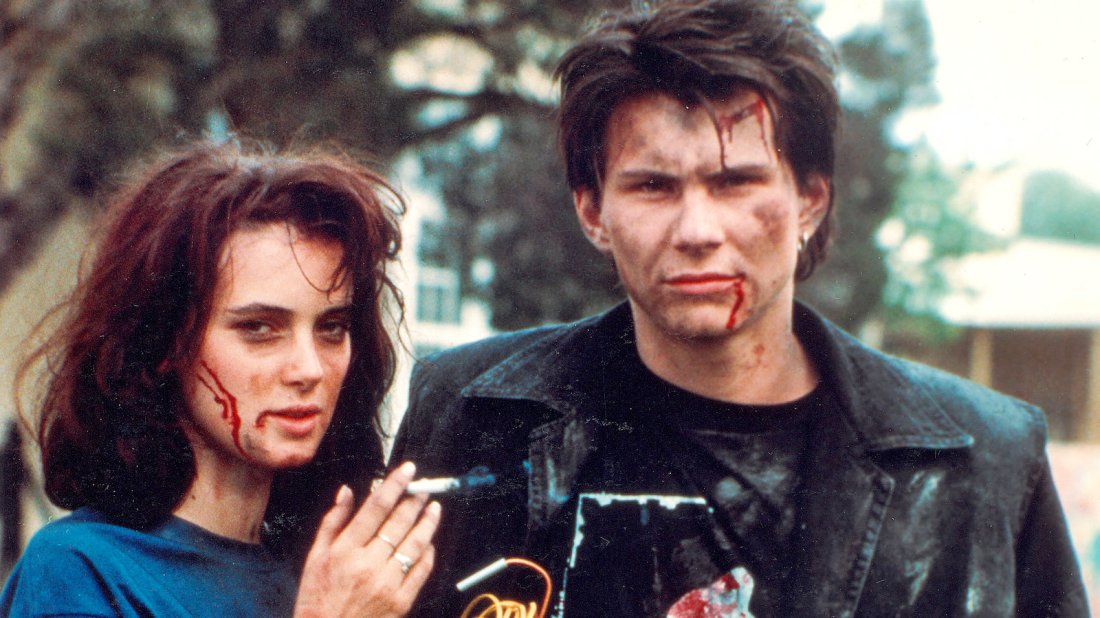
Christian Slater and Winona Ryder star as Bonny and Clyde duo Jason and Veronica


Heathers: 27 years is, quite obviously, a tad late for a movie review. Having the review, just the 5th on this blog, be a philosophical analysis of 80’s teen comedy Heathers is also painfully random and most definitely not a good way to build a strong reader base going forward. Nevertheless, while I needlessly procrastinated finishing the second half of my last post (or doing something actually worthwhile like, oh I don’t know, homework), a friend of mine convinced me to watch the movie Heathers with her and I knew instantly I had to write about it. To her, the movie (and the subsequent musical adaptations) had earned an almost religiously fanatical devotion, and her incessant habit of quoting every line before it was spoken had echoes of a priest reading scripture. So par for the course, it was only natural that she needed to spread its good word to the masses.

I was always going to be an easy convert.

80s parodies, from Airplane and Naked Gun to This is Spinal Tap and UHF are far and away my favorite comedies (and movies in general) ever made. Their eagerness and sharpened ability to tear through the realities of American life come off just as fresh today as they did back then. And while they never managed to hit terribly close to home, classic high school comedies like Clueless and Mean girls (the two most obvious comparisons my lazy-ass was willing to come up with), offered adorably farfetched daydreams of the social Serengeti of school in an undeniably entertaining manner.


And yet, I was never prepared for Heathers.


As it turns out, Heathers is not in the same ballpark as any of its contemporaries. In fact, it isn’t even playing the same sport. The level of ambition was simply unparalleled.  While other contemporary films had funny scripts, Heather’s screenplay (written by Daniel Watters) is an uproariously funny poetic opera; a neverending onslaught of quotable lines are intricately sewn together in an utterly spectacular commentary on humanity and modern society. But as much as it may sound like the Casablanca of the 80s, Heathers has none of the same romantic or practical sensibilities. Other teen films of the time were revolutionary for their portrayals of the modern high school reality, yet they always seemed to mix their satire in with an endearingly nascent sense of general optimism and heroism. Heathers pulls no punches. It is a macabre carnival of selfishness, evil, death, and twisted reality. And it is with this latter note that it becomes, and I say this with 100% certainty, a near-perfect existential masterpiece.

Like many a high school teens, the world of Veronica Sawyer (played by a very young Winona Ryder) is not right. She sold her soul to gain “popularity” and now hates her plastic reality — primarily, her 3 friends all named Heather (or as she describes them “a bunch of swatch-dogs and diet-cokeheads.”).

Luckily, the solution to all her problems comes in the form of rebel bad-boy Jason Dean. Christian Slater was reportedly considered for the role of Heath Ledger’s Joker and he shows why here, his slow midwestern drawl dripping with disturbed malice as he etches his mark in cinematic villain history.

After his anti-establishment swagger peaks Veronica’s interest at school, the two instantly form a relationship. And Jason, by happenstance, has the solution to all of Veronica’s problems. After a particularly rough fight with the abusive ringleader of the Heathers, Jason tricks Veronica into giving drain cleaner to her. To cover up, Veronica forges a suicide note which quickly creates cancerous repercussions that soon consume the small town. 

Thus begins a pitch-black drive through an exaggerated yet recognizable version of our own reality. Inspired by classic existentialist fare, an abundance of warped views, redundancies, and death work to create a chaotic and revolting sense of confusion that emphasizes the hollow nature of suburban existence.

Basically, it’s Waiting For Godot but with a lot more death.

Murder and rape fill the movie to the brim, but somehow nary a tear is ever shed for the victims. To the audience, their demises are presented just as jokes, and to the characters of Heathers, they don’t even register enough to reach that level. They are simply plot points that happen, only mattering in the gluttony of personal consequences they bring with them and touching none of the entire selfish cast of characters in a more empathetic way. They are an opportunity to advance socially for a Heather, a chance for a teacher to show-off her “new-age healing” powers, or just a brief TV News headline for the masses. Why this is, Heather argues, is just as nauseating today as it was then. For instance, in one pair of over-the-top scenes that had me seriously questioning whether to laugh or be petrified in terror, Veronica has a near identical word-for-word conversation with her parents. Yet in the latter scene, Veronica’s mother puts a poisonous spin on an age-old question, cheerfully asking “How was your first day at school after Heather’s suicide?”. The death simply wasn’t personal, so in this urbane existence, there was no need to care. 
heathers-watching-recommendation-videoSixteenByNineJumbo1600
An 80’s high school comedy transcends time as an Existential work of art? You bet ya!

While these reactions are obviously exaggerated, their origin is an unnerving kernel of truth in the faults of humanity that shines crimson red throughout the picture: faults that stem from the constant unseen battle between the individual and the masses. That’s why a high school setting, in all its awkward Lord of the Flies Glory, is so effective as a microcosm to study society as a whole. To the people involved each excruciatingly small detail of their life matters personally, but to the outside we see only amorphous blogs of geeks, popular kids, jocks, and administrators mixing and bouncing off each other in an eternal dance. For example, while we clearly empathize with the abused group of surviving Heathers, they instantly take up the evil mantle of the dead Heather in their fight for power over the school. Thus by naming them all Heather, screenwriter Daniel Watters highlights their potential to be absolutely identical in the grand scheme of things.

Therefore, as Jason explains in one scene, why should it matter if a bully like Heather dies. She was undoubtedly a negative influence on society, so why should her death matter in the grand scheme of things? In a society such as this one where the concept of the individual is completely absent, her death doesn’t matter. Heathers even goes so far as to make this point literally: in one particularly ominous instance, Jason repeatedly addresses his father as his son and gets addressed like he was the dad. Like Rosencrantz confusing himself with Guildenstern, people in this film simply seem to forget who they are.

However cynical as Heathers can seem at times though, it smartly pushes back against this purely negative outlook. Instead, Heathers argues, people like Veronica can find meaning in life by overcoming their selfish pursuit of power, and instead, learn to find solace in maintaining friendships and caring about the hurting. Because as much as Heathers is a warning about the all too available paths to selfishness in one’s hearts, it is a plea to value others and the time we share with them. A plea to maintain that important friendship, or give a hand to the downtrodden. As one defining statement from a character from Heathers goes “Whether to kill yourself or not is one of the most important decisions a teenager can make”. This sounds an awful lot like Albert Camus’ perennial question: “Should I kill myself or have a cup of coffee?” But thankfully, as long as that cup of coffee is shared with a friend, Heathers chooses the latter.
What’s the Point of Watching Movies with Friends? (Part 1): Drowning in Chicken Burritos and Dismay

burrito
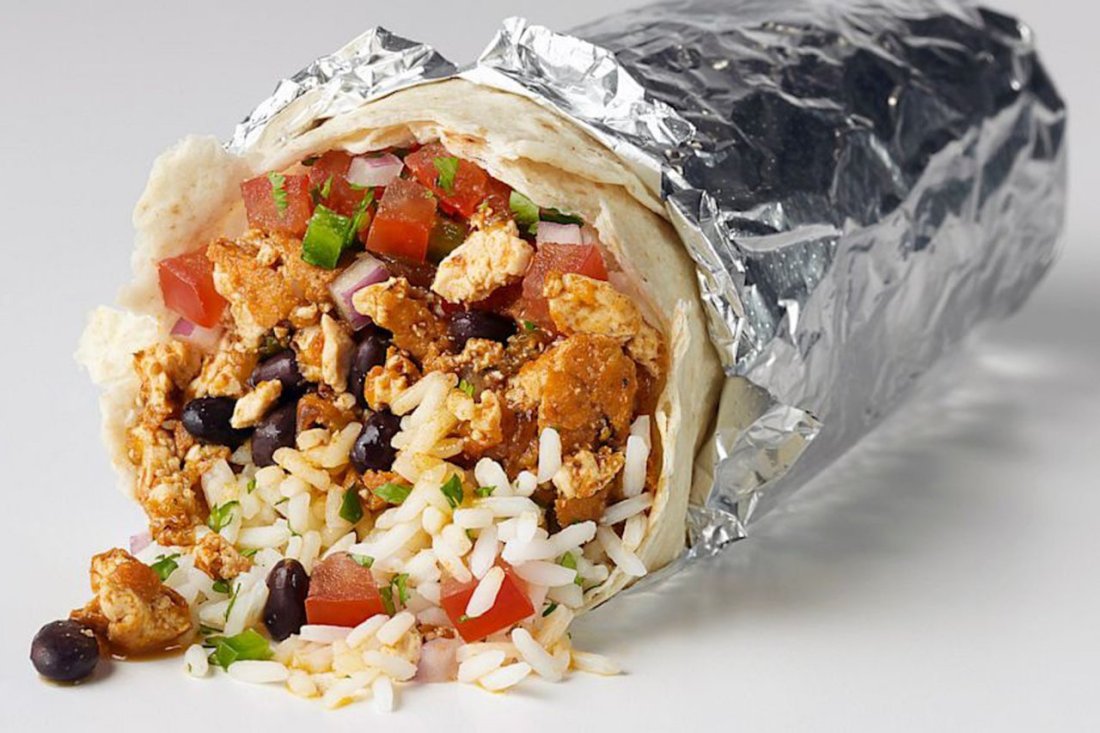
A “tragic” story of loss.

By far one of the greatest benefits of my local theater growing up was its close proximity to what was essentially large, open-aired food court. Composed primarily of fast-casual chains, none of the food was particularly revolutionary (or cheap). Yet to middle-class suburbanites with cash to spare like ourselves, the consistency of well-regulated mediocrity tapped into the beating heart of our essence and we simply couldn’t get enough.

Before going to a movie, we’d congregate like a cult of locusts around the mall and swarm on whatever met our fancy for that evening. For me (and most of us), that tended to be a burrito from Chipotle. Overstuffed with a smore-gus-board of Mexican culinary staples, from the sizzling and oh so juicy meats and beans to the snap of fiery spices and freshly sliced vegetables, and all topped off with just a sprinkle of Ecoli. It was definitely worth at least 7 of the 9 dollars I ended up paying for it. Besides just the trivial taste factor though, it carried the unparalleled benefit of its transportability. Neatly wrapped in shimmer tin foil it was of little contest to carry and eat it anywhere, but most importantly the theater itself. Now the movie was obviously the main event, but my habit of eating Chipotle during the show forced the two into an often indistinguishable symbiotic “Salsa” (oof).

I don’t remember what we were watching that night. In fact, don’t really remember much about the night at all. Per usual, my friends and I grabbed food from the mall and walked over to the theater. Then, I’m sure, we watched whatever mediocre flick happened to be playing before floating away together into the haze of another fun yet indistinguishable summer hang-out.

But it is what happened in the middle that I will never forget.

Immediately after taking our seats, the whole lot of us began acting as we always did: wisecracking jokes and playing crude verbal tennis. Nothing to truly offend the people around us, mind you we were older enough at this time that most of us to various degrees had developed something resembling a filter. But of course, a mass of high school boys isn’t exactly going to sound like a library. Now it’s important to note for this story that the movie had not yet started. In fact, not even the previews had begun. Instead, it was Maria Menounos’ voice that echoed around the auditorium, bringing with it the sweet sound of endless advertisements. The calm before the storm.

Maybe I was being particularly “rambunctious” compared to my smiling gang. Or perhaps it was just a matter of proximity. But just like that the man sitting in front of me whipped back and locked his cold, callous eyes with me.

And the world turned cold.

I still see the ghostly figure to this day. Sickly white skin painted the muscular outline of a balding-man closely reminiscent of the stereotypical Aryan prisoner. A pair of menacing caverns of darkness stared back at me, slicing cold icicles into my motionless soul. He screamed in ferocious whispers, berating me for the disrespect we showed by talking and even threatened to call management.

My response to the man, of course, was most eloquent and quickly diffused the situation: “Dude, the trailers haven’t even started yet!”.

Yeah. That went over great.

The lecture had been tinged with a deranged undertone (can you really expect any different) and there was a deeply unsettling menace radiating from the man, but none of it at all foreshadowed what came next.

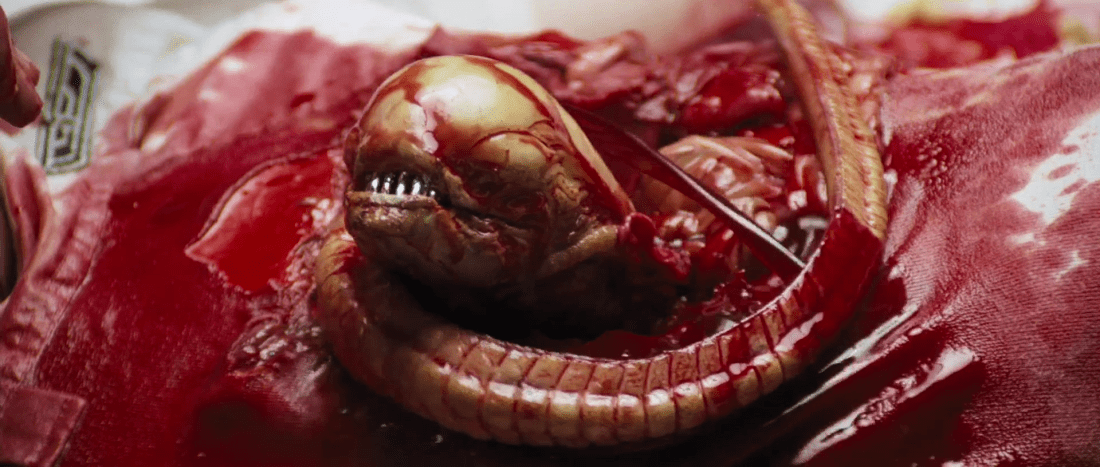
Like the chest burster-from Alien, a hand, his hand, suddenly sliced through the air before smashing into my still warm burrito. The hand impaled the burrito and pressed hard against my chess. A mixture of Mexican food bleed onto the floor, as any illusion of restraint from the man disappeared in the blink of an eye. I tried to save face with a small sardonic smirk, but make no mistake: I was frozen to my very core. Evidently, the man did not appreciate my impudently carved mask. He finished his fearsome rant by tossing my mushed burrito to the ground. Bits of chicken and rice flew in a serene arch through the air and rained down upon the dim floor below. Then the man, mercifully, sulked back around and left me to bathe in my indescribable shock.

But my burrito- my lovely, tasty burrito- was no more.

ChestbursterA11080
Like I said, a tragic story of loss. A story of burrito loss.

The man turned around sometime later to apologize for his outburst before suddenly getting up and leaving midway through the movie. I must admit after recent theater shootings in the news I was definitely (but not at all rightfully) on edge for the next half hour. But thankfully he vanished into the night, never to be seen by me again. In truth, I still feel bad for the man. He was obviously sick, and despite the obstacles our country’s healthcare system provides I hope he gets the help he needs. And while I’ll still laugh about the incident with my friends today, it is nothing but a joke now. A meme. Not some scarring assault. But nevertheless, something did strike me hard that night and leave a mark: the sinking disappointment that I would no longer be allowed to crack jokes or observations with my friends for the rest of the movie.

I try not to be a talker during movies. Truly. I can’t stand people that are. But what in God’s name is the purpose of watching a movie with other people, especially a mediocre one,  if we have to be stone-cold statues the entire time? I don’t just mean talking loudly, of course, that’s infuriating to sit next to. But even whispering. Even breathing emotions into our company’s ears gives the experience a purpose.

What’s the point otherwise?

And indeed I have wondered exactly this to this very day. So many hangouts either culminating in or more often originating for, the purpose of watching a movie together. And yet, despite the rare garbage dump which allowed us the opportunity to turn into the shadows from “Midnight Science Theater 3000”, watching a movie was a silent experience. Like a less holy version of Synagogue. No doubt it gave us a reason to hang out, but all too often that was its main purpose. Sure there’s the element of shared experience, and for the film geeks in our group, it gave something to analyze and debate for hours together. But more so the lack of conversation blasted my ears, and the movie felt like the mandatory commercial break for our hangout. The price of admission for getting to enjoy each other’s company.

So what’s the point of it all? Why in our film culture in America, is everything so precipitated on dead silent theaters being a social experience?

(Part 2 will be released soon.)

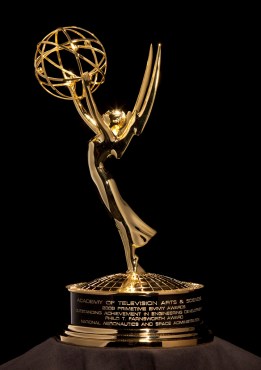
The Allure of the Emmys

emmy
The golden trophy rewarded for the pop-culture friendly TV shows.

The transition to college brings many substantial changes with it, but by far one of the biggest ones is a general feeling of disconnect. “Disconnect from what?” you might ask, but of course the question does not have one simple answer. Living on campus you deal with the reality of your campus life. Classes, clubs, dining halls, social interactions, and studying become your life. That’s of course not to say there’s no contact with the outside world. On the contrary, the news is still accessible and phones and email give one the easy ability, of course, to keep in touch with friends and family far away. And yet there is still that feeling, that nagging feeling, like the one I’m sure many have felt on a boat slowly drifting across the horizon. College is a place of purgatory, seemingly separated by sheer cliffs on each side from the golden normalcy of a suburban childhood and the towering mountains of a successful adulthood. Therefore when I saw the news alert that the Emmys had begun, I jumped for the first time in over a month of college to watch live TV.

Be it the Emmys, Oscars, Tonys, Golden Globes, or whatever other knockoff events Hollywood could stuff a few celebs into, my family and I would watch these events with a religious dedication growing up. The pie in the sky high-rises of the American dream roped us in with spectacular showmanship and shared experience: “Hey I saw that movie!” or “Hey I know that actor” were all it really took to be swept off your feet and pulled to the shining rafters. Even when I had no knowledge of the movies or actors present, there was always something so safe about grown-ups talking so damn elegantly.

They were professionals, and by god, they looked the part.

So when that alert danced across my screen I instantly found the excuse I needed to procrastinate on my homework. It was sentimentality, awe, comedy, and the certainty of adult success all rolled into a couple hours.

So how was it? Basically what I was expecting actually. Many of the jokes were lame and of course, it ran a couple hours too long, but that taste of pompous entertainment awards truly delivered. The music and booming announcers voicers waltzed effortlessly around my ears, and I let myself be carried by golden statues to the overproduced world of my dreams. In fact, I even knew some of the winners! The Good Place was ignored again of course but The Marvelous Miss Maisel and Barry are both definitely worth checking out (streaming on Amazon Prime and HBO respectively).

While of course not the perfect event my memory always cracks it up to be, the allure of the Emmys was completely on display for me this time. For a night I was safe in the certainty that my previous life did not simply end the day I left, and that the future, however uncertain, was still just one overlong display of glorious possibilities waiting to happen.

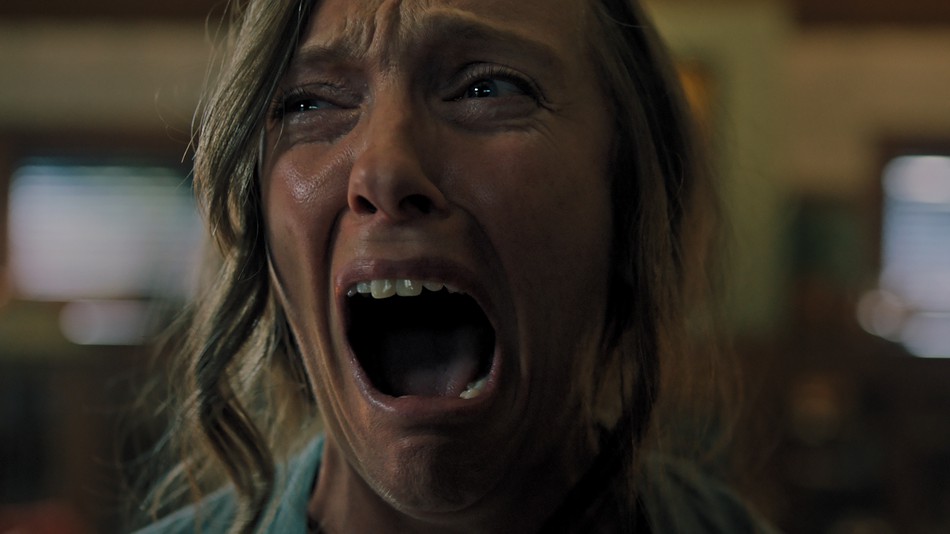
“Hereditary” Adds Yet Another Strong Addition to the Recent Horror Revolution, but Ultimately it’s Just Not That Scary

face
Tony Collete is absolutely horrifying in her starring role, yet Hereditary lacks the same scary zeal.

Hereditary:

Tell Jason he can finally rest easy. The horror genre has roared back to relevance in recent years and by god, it just might be better than ever.

After decades of nothing but simply unwatchable low-level shlock overflowing with horny teenagers poked full of holes and gruesome gorings of the “mostly” innocent in near-pornographic ways, recent years have seen the rise of a number of indie flicks that for the first time in history actually seek to achieve something that resembles cinematic virtue. Hereditary is the newest film to seek this higher calling, and yet while its metaphorical musings and high production quality definitely raise it above the trash of the past there’s just one thing I just can’t get past.

It simply wasn’t that scary.

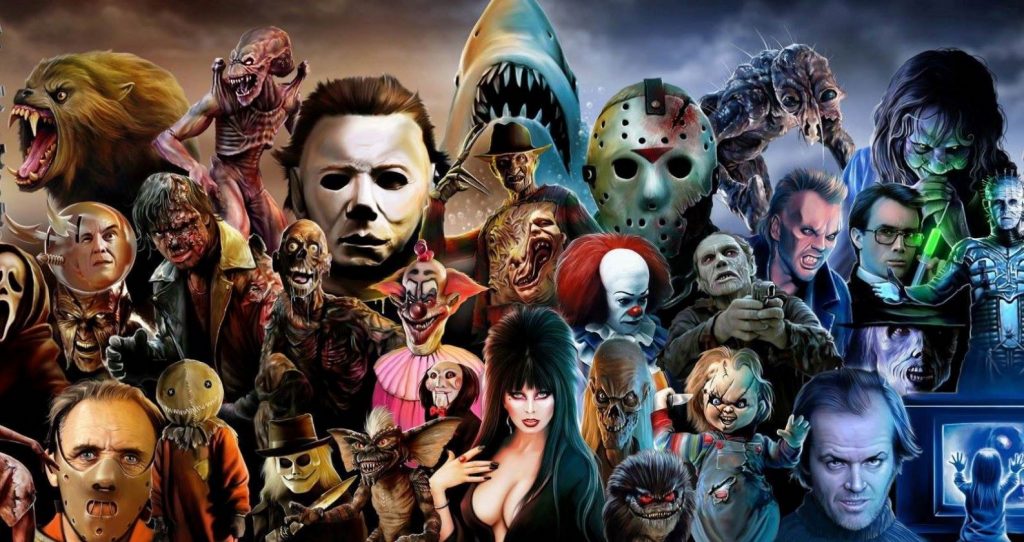
Of course, fear is inherently subjective and no doubt many have and will find Hereditary to be nothing sort of bone-chilling. However, compared to the level it could have attained it feels nothing short of a technically beautiful swing and a miss. And it’s not alone. From The Witch to It Follows, Get Out, and It Comes at Night, numerous recent “quality horror” films are all well-made in their own right, and yet they lack the nightmarish punch of an “Exorcist” or “Nightmare on Elm Street”. Films that grasped the neck of America with cold, bony hands and strangled until the blood ran cold. It’s not just the new scary art pics that lack this power. As fantastically blood-curdling a ride The Conjuring and moments from its sequels are, they too have lacked the power to truly transcend a gasping theater. It’s fair, I think then, to wonder just what a truly transcendently haunting horror movie would look like in the age we live in – the age where nothing unseen stays that way for very long.

horror-movie-icons
Where are the horror icons of today?

For whatever hereditary lacks in scare factor though, director and screenwriter Ari Aster does a commendable job managing to craft a darkly compelling tale of family and the sins we inherit from our parents. Following the death of the Graham family’s grandmother (an odd and abusive figure who is obviously not sorely missed), the remaining family members are put through a grossly twisted ordeal as they struggle to fight a mysterious darkness while maintaining their own shreds of sanity. While the first two-thirds are often lacking of traditional scares, the film’s exploration’s of loss and mental illness are often profoundly well done and carry the movie well beyond what could reasonably be expected of them. Likewise, stunningly traumatizing performances across the ensemble but most memorably from star Tony Collete (the mother) and Alex Wolf (the son) will be seared into your eyes for days to come. In fact, these elements transform what could have been a frozen slog into a consuming movie.

But yet again, the lack of true terror stunts any greater ambitions.

Besides for the few shockingly effective moments that terror you from your seat and stuff you face first into nightmarious left-turns, too much does the first hour and a half rely on an all too lazy “slow burn” (a common buzzword in horror nowadays which simply means not scary). The lack of a present threat or the occasional jumpscare aren’t condemning in their own right, but they’re sorely missed here. And as much as they may seek to be a reliant homage to movies like “Rosemary’s Baby”, the ghostly whispers of Hereditary’s villainous forces ultimately come off as just plain boring; a repetitive archetypal antagonist that simply has no place in horror movies of today.

Of course, that’s not to say nothing in Hereditary put me on edge. On the contrary, when Hereditary finally decides to stop sleepwalking in the final half hour it put on a tour-de-force of heart-stopping terror. Petrifying, tragic performances dance satanically with well earned nightmarish portraits and a truly terrifying use of color contrast. In fact, if the entire movie could have run at this pace I may just be raving about a true return to terror.

But it didn’t and I’m not.

Because in the end as well made as recent horror movies like Hereditary have been on a technical level, and no doubt Hereditary is a “good” movie, that missing element of horror still binds them to the muddied grave that they so desperately seek to crawl out. In 1931 Dr. Frankenstein famously screamed “It’s alive!” as his monstrous creation jolted awake. Just like that freakish creature, the corpse of the horror genre has been miraculously stitched back together and forced onto the wide eyes of a petrified public.

Now if it could just be half as scary.

B-

It’s a Fun Ride, but “Ready Player One’s” Hollow Imitation of the 80’s Makes for a Disturbing Viewing Experience

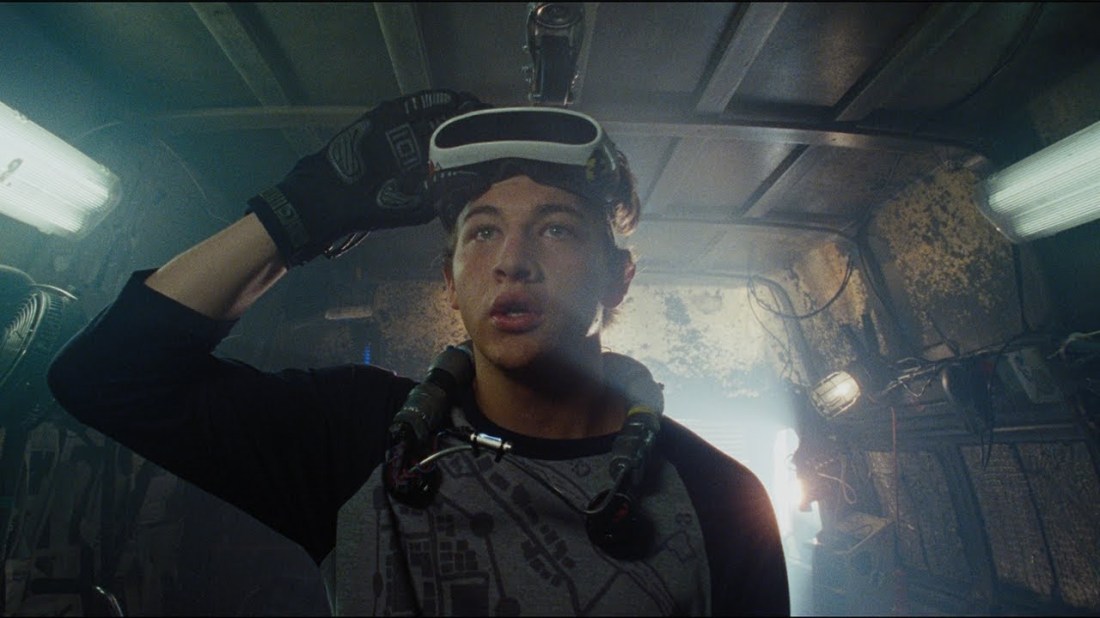
maxresdefault.jpg
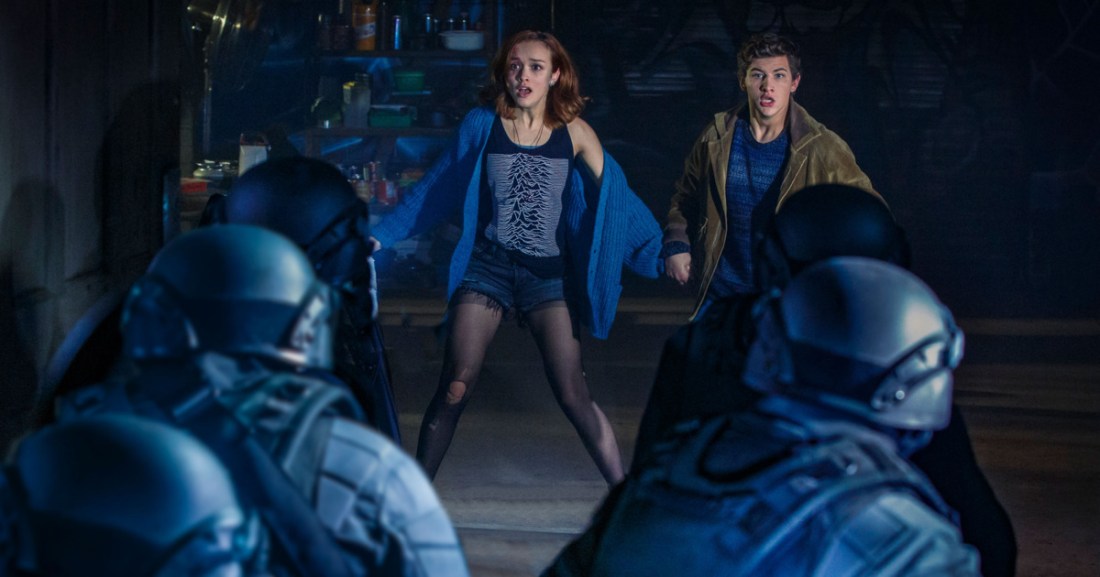
Tye Sheridan stars in this futuristic look at recent American history.

Ready Player One:

How great were the 80s in America? That’s not a rhetorical question, because as someone born at the turn of the new millennium, I have absolutely no clue. The enduring sentiment in popular culture paints the decade as mythical; a prismatic fountain of opportunity and youthful adventure. In few places can this be seen better than by our countries continued and seemingly unbreakable reverence for the movies and entertainment that defined the 80s. From Ferris Bueller to Star Wars, visions of fantastic adventure and revolutions by the young against dreary monolithic evils were displayed with such zeal by the filmmakers of the time that it would not be unreasonable to mistake them for the endless barrage of rousing canvases that poured out of the French Revolution.

I do think it’s fair to question whether these movies and the collected memories they construct represent the true nature of America and Reagan’s similarly towering, monolithic government at the time. Ready Player One, however, the extremely off-putting new film based off Ernest Cline’s smash hit book of the same name, chooses to treat these movies as near-scripture to the era they represent.

Set in the graying dystopian world of America in the year 2045, Ready Player One stars Tye Sheridan (Mud) as awkward orphan Wade Wotts. You’ll be forgiven if you mix up Tye Sheridan with any of the identical, recent studio pushed young white male actors (like Taron Egerton from Kingsman or Ansel Elgort from Baby Driver). And in a performance so devoid of emotion and range that it’s most reminiscent of stale toast, Sheridan does not particularly set himself apart from the crowd. Wade, like the majority of humanity, lives most of his life in a massive virtual reality video game named the OASIS. A descendant of the internet and open world video games of the present, in the OASIS you can be whatever character, fictional or real, that you can possibly think of and explore a world filled quite literally with everything you can possibly imagine.

Mostly, though, it’s stuff from the 80s.

The reason for the games seemingly random, fanatical devotion to the 80’s is actually a largely ingenious set-up. You see the creator of the OASIS James Halliday, played by the venerable Mary Rylance (Bridge of Spies), set up a scavenger hunt in the game just before he died. As absolutely fantastic as it is mind-bogglingly conceited, Halliday drowned the OASIS in anything and everything related to the decade from his youth and left the world to sort through it to discover three mysterious keys and win control of the OASIS. This small yet blinding ray of hope has inspired the mud-dwelling masses including Wade (or as he’s known by his screen name Parzival), to run from their crumbling reality and gorge themselves during their Klondike rush through the virtual Garden of Eden. The result is an aimless and dying world too busy leaning on the pleasures of the past to look towards the future (sound familiar).

However, like the book itself, the script, penned by Avengers writer Zach Penn (god I know) and, in a big mistake, by the novel’s author Ernest Cline, Ready Player One is much happier ignoring any bigger questions and instead focusing on their elaborate easter egg hunt. Wade becomes the first person to find key #1, and along with love interest Samantha (screen name Art3mis) who is played by hidden gem Olivia Cooke (Thoroughbreds) and token black best friend Aech who is played by the charismatic Lena Waithe (Masters of None), they embark on their quest through a breathtaking mixture of colorful words and nostalgic wonderlands to win the prize. Opposing them is the sinister corporate head Sorrento (played with a ferocious dryness by Ben Mendelsohn in a role strongly stylized after Principal Vernon in The Breakfast Club). Other stars like TJ Miller and Simon Pegg also make appearances throughout, along with a colorful host of famous characters.

28-ready-player-one.w1200.h630
Unnamed members of the fun police stand in our heroes way.

Now for its credit, the decision to let the animation, action, and nostalgia take center stage is not completely without merit, and the immediate effect is a thoroughly entertaining thrill ride. Helmed, and rather masterfully so, by none other than Stephen Spielberg, Ready Player One crams in a near infinite amount of beautifully realized pop culture artifacts and a sensory overload of masterfully executed action scenes reminiscent of the blood-soaked opening of Spielberg’s Saving Private Ryan. And while the relentless onslaught of easter eggs turns numbing at times, they produced in me a consistent giddiness throughout not unlike that of the first time I went to Disneyland.

Yet as fun as these scenes on their own can be, Ready Player One’s conflicting and often blatantly missing viewpoints on its urgent and timely issues came off as more than simply a missed opportunity. In fact, the film’s glorification of humanity’s decision to reject their natural progression, and instead choose to lock themselves away in hollow animations of the past is deeply disturbing and Ready Player One quickly becomes the very antithesis of the noblest themes of the decade it claims to love. How is it that a movie that declares its love for the ideals of revolution and fighting against the status quo, is so content with allowing the unmitigated death of humanity and bravery?

The answer is that Ready Player One isn’t truly inspired by the 80s. Just like the subjects of the film, it remains trapped in an uncanny valley imitation of the American 80s. The certainty and unfettered sense of wonder from childhoods that defined the work of legends like John Hughes and an earlier Spielberg is no more, and Ready Player One is left to flail hopelessly at the flawed memories and hopeless nostalgia of an audience that is stuck in time. All the while it forgets what made the classics of the 80’s so relevant. The tenants of human greatness that must also be allowed to thrive today.

Where’s the rebellion?

Where’s the spirit?

Where’d the fight go?

C

It’s Not Crazy Good, but “Crazy Rich Asians” is a Monumentally Important Rom-Com

Crazy-Rich-Asians-Movie-2018
Michelle Yeoh, Henry Golding, and Constance Wu star in the amicable yet absolutely vital “Crazy Rich Asians’.

Crazy Rich Asians:

Being the first to break any sort of social barrier is seldom an enviable position. For every Jackie Robinson that smashed their way into the history books and forever changed the world around them, how many tormented souls melted under the scorching heat lamp of public opinion? That’s why in the end, as scattershot and flawed as it was at times, Crazy Rich Asians is such a satisfying success. The first contemporary, all Asian film in nearly three decades produced by a major Hollywood studio, Crazy Rich Asians was forced to carry more on its back than its story’s modest mixture of romantic comedy and disapproving parents. As Asian immigration to America skyrocketed over the last few decades, the supposedly purely capitalist sentiments of Hollywood ignored the chance to capitalize on a potentially major, untapped demographic. In the ever-increasing media frenzy in the months leading up to its release though, Crazy Rich Asians was hailed as the cultural touchstone that was going to change everything. And while not by any means a historically great movie, a charming (and suitably gorgeous) cast and an excess of funny moments make the picture a crucial blast.

Based off the smash hit novel of the same name, Crazy Rich Asians follows a pair of perfectly suited lovers as they attempt to navigate the murky waters of family, love, loyalty, and money across the spectacular neon skyline of Singapore. The movie stars Constance Wu (from Fresh Off the Boat fame) as the sweet-natured Rachel, a first-generation Chinese-American economics professor, and Henry Golding (a long time travel host with looks that would make a prime Paul Neuman blush) as Nick Young, the super rich but gold-hearted heir to an unfathomably powerful real estate company based back in his home of Singapore. This latter note provides the primary conflict for the film, as Nick decides to take Rachel back for his best friend’s wedding and in doing so reveals his family’s true “royal” status to her. Rachel, like most viewers I’m sure, is instantly struck by the magnificent mix of sizzling street food and impossible, grandiose architecture (as she quips upon arrival: “I can’t believe this airport has a butterfly garden and a movie theatre. JFK is just salmonella and despair.”) And yet while her fish out of water experience in the lavish yet foreign playgrounds of Singapore provides a constant and thoroughly successful source of amusement throughout the film, it does not ultimately provide an obstacle for her relationship with Nick.

No, as is expected in romcoms as the sun rising in the morning, parental approval (or more so disapproval) is the decisive element.

Nick’s mother, the glowering Eleanor Young (played with phenomenal zeal by legendary Crouching Tiger, Hidden Dragon star Michelle Yeoh) is, to say the least, not happy with Nick’s choice of Rachel. To Eleanor, Rachel is simply a low-class American distraction for Nick (a “banana” as one of the characters puts it) who should instead choose his family and predetermined path. Yet despite Eleanor’s socially conservative attitudes which may make her seem weaker than the Robert De Niro parental adversaries of the past, Michelle Yeoh’s displays an unnerving steely-eyed gaze and unwavering cunning in early scenes that help instantly establish her as a worthy and sympathetic antagonist.

In fact, it is this more nuanced and endearing look at old-fashioned Asian ideals that provide some of the more interesting and (probably for many Asian-American viewers) relatable moments. However, the movie never seems interested in truly digging deeper into the far more complex and interesting subjects of cultural and parental morality. For every small glimpse we get of the familial philosophy of dumpling making, obnoxious and over the top catfights, bland cliches, and a weak attempt at a subplot involving Nick’s sister are there to undercut the film. And while the magnificent displays of wealth offer jaw-dropping entertainment for a while, it becomes hard to stomach the film’s florid fantasy of a borderline Hunger Games display of excess (especially in the context of the region’s every increasing wealth inequality).

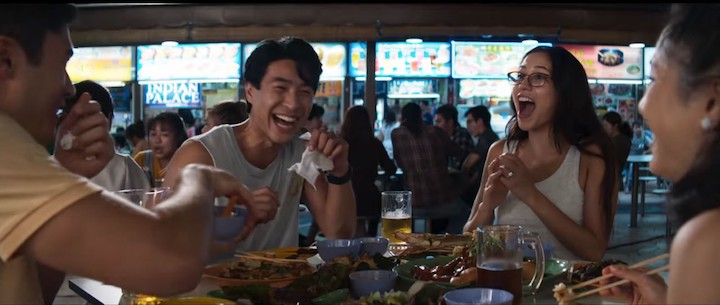
But of course, Crazy Rich Asians never needed to be a transcendent social commentary. Success meant making a delightful romantic comedy, and that it does to a considerable extent. After several bargain bin movies, director Jon Chu (of considerably less flashy GI JOE: Retaliation fame) finally gets the chance to put his own flourish on a movie in the big leagues. And flourish he does as whatever the script lacks in complex analysis of its subjects, Chu makes up for in dazzling shots of Eastern wealth, food, and culture. We as the audience have the pleasure to feast on endless, mouth-watering displays of meats and soups and noodles and dumplings, mashed end on end with a rapid succession of colorful cuts and tied together with an orchestral of sizzling grills and boiling pots and the scrape of quickly emptying plates. At the same time, we are blinded by the flashes of orange, green, and purple fireworks which illuminate the futuristic opulence of dramatic water features and towering yet undeniably beautiful buildings.

food
Expertly filmed buffets of local cuisine offer a fantastically indulgent feast for the audience to experience.

And while the light and safe nature of the script, which was written by the duo of Adele Lim (Lethal Weapon TV show) and Peter Chiarelli (Now You See Me 2), is ultimately its biggest downfall, it still provides a funny and occasional misty-eyed backing from which the cast can really shine. Breakout star Awkwafina, who plays Rachel’s old college friend with the eccentric and comedic delight of a young Jack Nicholson, and her screen dad Ken Jeong (The Hangover) are just two of a host of colorful characters that shine throughout the movie.

So while the messy spectacle of beauty and comedy and adorable love never amounts to an all-time great work of film, it still succeeds in being an enjoyable movie. For so many Asian Americans that much of popular culture has forgotten for far too long, it’s colorful competence is nothing short of a triumph.

B

The Stunning “I, Tonya” Succeeds in Presenting a Hilarious Yet Tragic Condemnation of the American 24 Hour News Cycle

I-Tonya-70
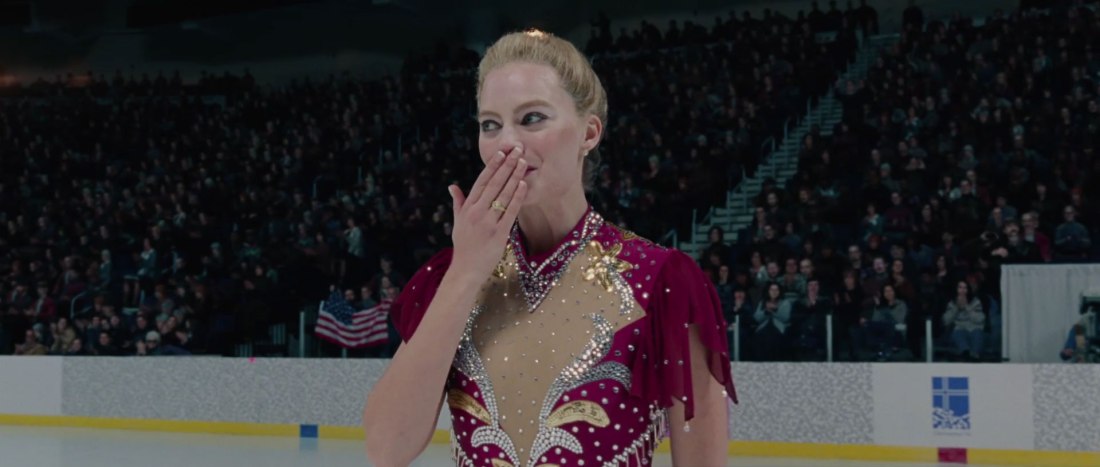
Margot Robbie (The Wolf of Wall Street) stars as unenviable Tonya Harding

I, Tonya:

The alarming, unwholly matrimony of news and the internet finally came to a disastrous front in the last election, illuminating to many the serious challenges technology and more so accessibility bring to journalism today. The truth, however, is that these dangers have been both present and consequential for far too long. I’m referring, unfortunately, to the infamous, ubiquitous 24-hour news cycle. And it is this all American institution that the phenomenal I, Tonya attacks with the ferocity of a rabid bulldog, gashing its teeth through fresh wounds of unaddressed societal insanity while it hammers the complicity and direct responsibility of America and its press in the tragic fall of American hero Tonya Harding. In what is without a doubt in my mind the best movie of the year, I, Tonya puts on a filmmaking clinic as it perfectly balances tear-inducing sardonic wit with stomach-churning outrage, in turn delivering the Dr. Strangelove for this generation.

For those who either were not yet born or slept through the early 90s, I, Tonya follows the saga of American Olympic figure skater Tonya Harding as her once-promising career falls to shreds after her ex-husband hires someone to break teammate Nancy Kerrigan’s knee. Despite coming from extremely humble beginnings and experiencing severe physically and emotionally abuse from her mom and husband for years, Harding managed to achieve historic success and became the first-ever female American to perform a triple-axel. This, however, is not how she would be remembered. In the aftermath of the attack, the media turned the incident into a gargantuan overblown spectacle and Harding was tarnished as a sickening hick villain of mythical proportions. Despite her repeated contentions of innocence, America blamed Tonya for the attack and her livelihood was subsequently torn away from her as she was banned forever from skating. The true story behind the scenes, however, is one that no writer could have possibly come up with and indeed simply reciting the events in chronological order (as many biopics these days seem content to do) would have made for an entertaining couple of hours.

Luckily, this is not the road I, Tonya takes.

Driven by an unquenchable thirst for blood for the wrongs they perceive Harding has had to endure, director Craig Gillespie and screenwriter Steven Rogers put damn near everything on the table as they ambitiously craft I, Tonya as a stunning condemnation of the lie of American equality and sloth-like journalism. It draws obvious inspiration from the best of Martin Scorsese, meticulously twisting an electric world filled with vivid characters, a liberal use of voice-overs, popping one-liners, and unreliable narration, but no Scorsese film ever had anywhere near the ideological ambition of I, Tonya and therefore it’s hard not to argue that this film surpasses even some of his best work. Every abusive sucker punch to Harding’s face and every blinding flash of a camera struck me with equal devastation, and the hopeless reality of Harding’s situation left me shaken for days.

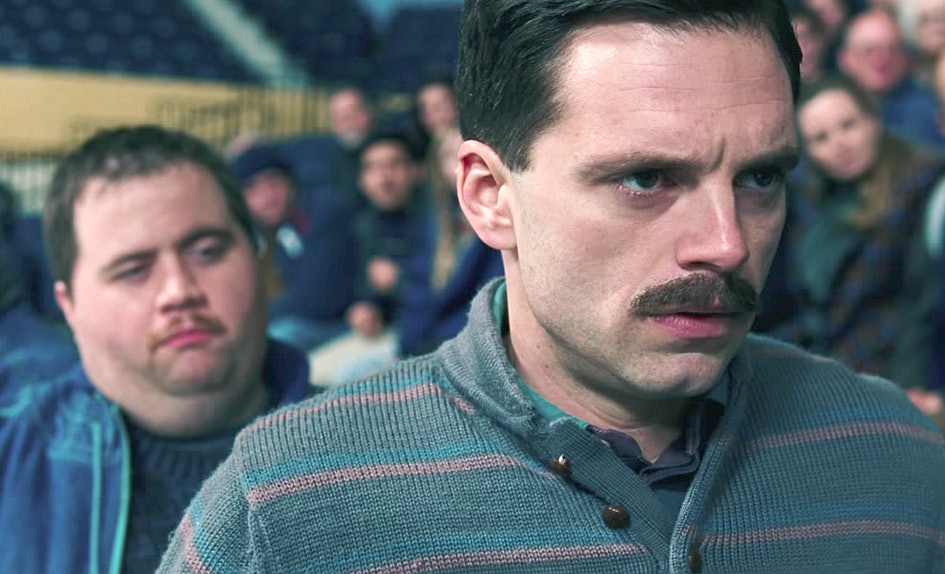
Of course, these themes come off as inherently depressing on paper, but while tragic and infuriating, it’s vital to note just how entrancing I, Tonya was to watch. Unsurprisingly, Margot Robbie (who also produces) knocks it out of the park in her titular role. In a performance that is well worthy of Oscar consideration, Robbie excels as the foul-mouthed yet sympathetic square peg in skatings untouchable aristocratic hierarchy. In the end, though, it is the standout work across the board by the stellar ensemble that adds the truly delectable zing to the picture. Allison Janney will get the praise (and well deserved) for her scintillating yet comedic turn as Harding’s abusive mom, yet it is Sebastian Stan (Captain America) as Harding’s somber yet monstrous husband Jeff Gillooly and Paul Walter Hauser’s breakout performance as bumbling yet uproarious “logistics man” Shawn (in yet another Oscar-worthy piece of acting) that truly bring the movie to new heights. Together, these characters are able to hilariously play off each other to create a spastic and unnervingly effective Shakespearean tragedy. Yet as strong as this ensemble was, for me it was ultimately the character without a face that was most effective at backing I, Tonya’s lofty accusations. I speak, of course, of the press.

twotonya
Jeff Goolly (Sebastian Stan) and Shawn (Paul Walter Hauser) steal the show as sickening yet hilarious goons.

More than just providing a breezy mixture of majestic tracking and low angle shots from the rink, cinematographer Nicolas Karakatsanis blurred portrayal of the hounding media creates a sickeningly claustrophobic atmosphere and helps transform the unseen monster into a very present antagonist. The looming flash of lights and colored dots even had the unnerving effect of putting me right into Harding’s shoes, and I felt her fear in a way that no tears or whimpering lips from Robbie could ever hope to coney.

Of course, I feel bad seeing the press as an enemy in a time where we need it more than ever, but I, Tonya is the difficult reckoning we all as Americans must face over our collective responsibility in the rise of a mainstream page 6 news. News so focused on ratings (or clicks), that facts and purpose are thrown at the wayside as previously professional journalism is turned into an interactive spectator sport. This is why I, Tonya’s successful use of unreliable and often opposing narration from the various characters is so crucial; more than simply compound the entertaining nature of the case, it shows just how inconsequential the facts behind this whole debacle are. What matters to the public is simply a good story, and any consequences are purely incidental. As Harding’s broken gaze chains us to our seats in one particularly powerful monologue though, we feel the disastrous repercussions of this dissociative mindset:

“It was like being abused all over again. Only this time it was by you. All of you. You’re all my attackers too.”

To America, Tonya Harding became simply a character. In suitably thrilling form, I, Tonya proves otherwise.

A


Introductions

Hi and welcome to my first ever blog post! Don’t know who’s actually gonna read this, but I’m sure it’ll be a valuable primary source for archeologists some couple hundred years for now.

My name’s David and I’m a student currently studying at the University of California Berkeley where I plan on majoring in History and/or Poli Sci (and/or practically any major, I have no idea what I want to do). I’ve loved movies my entire life, like so many other people I’m sure, and besides just reviewing I’ve been actively involved in both high school and college writing and creating movies. The ability to tell a story for any number of purposes allows artists to connect with people in profound ways, and I’m constantly in awe of the multitude of ways movies are able to succeed (or not succeed at this). Thus, by writing reviews I am able to feel that much closer to the works of film I watch and if my writing is good enough I am able to connect and share my viewpoints with my readers in much the same way a filmmaker can. And just maybe, I hope I’m an interesting and competent enough writer to succeed in this goal and so at least one or two people will read these reviews.

If not, a shout into the void never hurt anybody!

I’ll try to post at least 3 times a month. Mostly movie reviews, although I might go on a tangent here or there depending on what I’m feeling up to. Any feedback, arguments, new ideas, or just plain conversations is greatly appreciated!

-David

Hall Theater Cinema Curtain Film Screening Red
Let the show begin…